
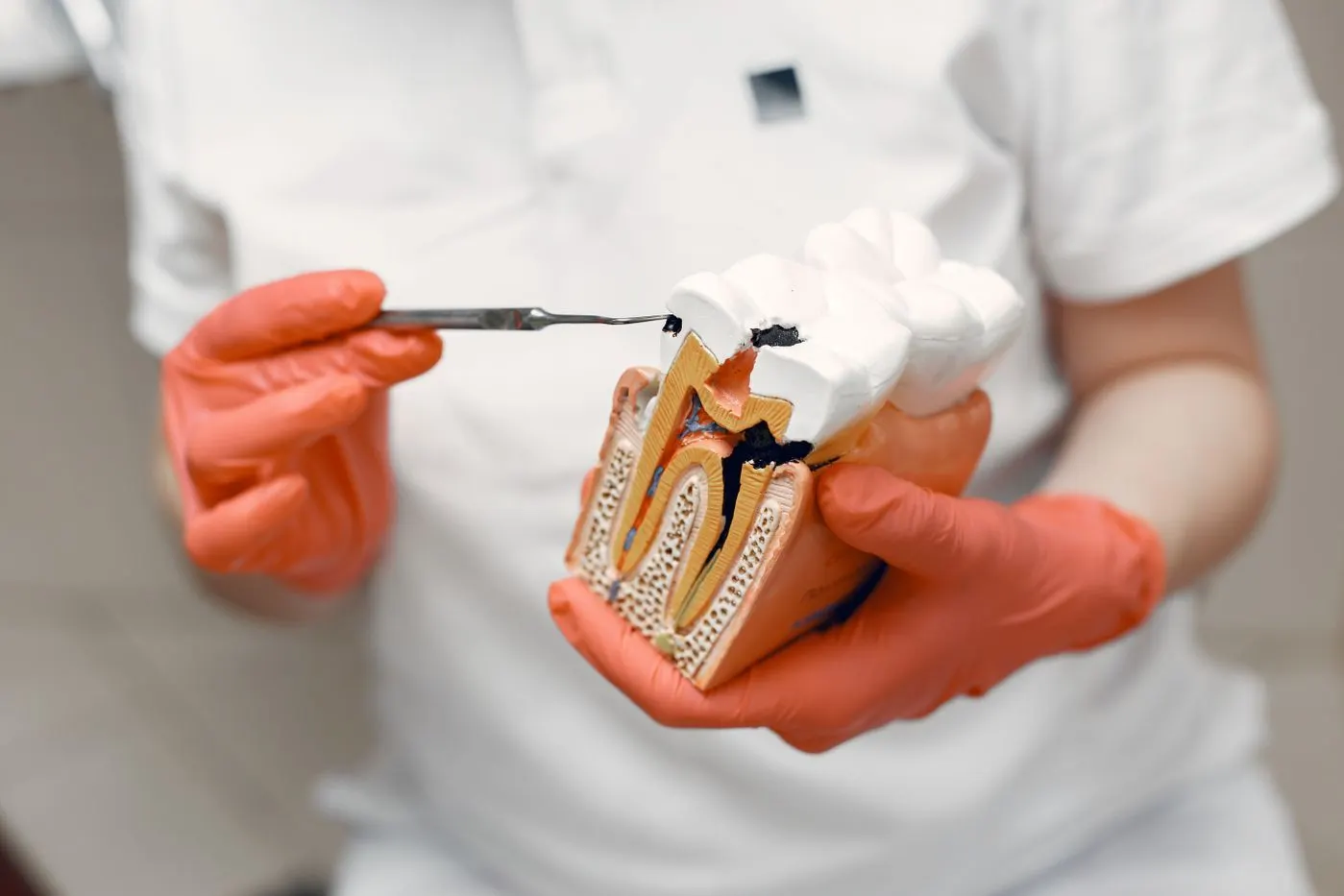
An apicoectomy (also known as apicectomy or root-end surgery) is a surgical procedure to remove persistent inflamed or infected tissue around the tip of a tooth root, together with a small portion of the root apex, usually when previous root canal treatment has not resolved the problem.
It may be considered when nonsurgical root canal retreatment is not feasible or is unlikely to succeed. The aim is to preserve the natural tooth where it can be predictably retained.
At Tadawi Medical Center in Doha, apicoectomy is performed by our oral and maxillofacial surgeon following a clinical assessment and review of appropriate imaging.
What is an apicoectomy?
An apicoectomy is a surgical procedure involving the end of a tooth root.
During the procedure, the surgeon:
- Makes a small opening in the gum over the root tip
- Removes the diseased tissue and a small portion of the root tip
- Prepares and seals the root end using a suitable biocompatible filling material, when indicated
- Closes the gum with stitches
Bone healing around the root tip takes place over the following months and is monitored when appropriate. Unlike conventional root canal treatment, which accesses the canals through the tooth crown, apicoectomy approaches the root tip surgically through the gum and surrounding bone.
Why is an apicoectomy done?
Inflammation or infection can persist around a root tip even after root canal treatment. Apicoectomy may be considered when:
- A crown or post would be difficult to remove for retreatment
- Curved or blocked canals, or separated instruments, make effective nonsurgical retreatment difficult
- A persistent periapical inflammatory lesion, infection or suspected cystic lesion remains despite appropriate endodontic treatment
A radiographic lesion cannot always be confirmed as a cyst without tissue examination. The surgeon may recommend histopathological examination of removed tissue when indicated.
Who is a good candidate for an apicoectomy?
Apicoectomy may be suitable for a previously root-canal-treated tooth with persistent periapical disease when the tooth can reasonably be saved and nonsurgical retreatment is unsuitable or unlikely to help. Suitability depends on clinical examination, radiographs, tooth restorability, periodontal support, root anatomy and proximity to important anatomical structures.
Who should not have an apicoectomy?
Apicoectomy may not be suitable when there is:
- A vertical root fracture
- Severe periodontal disease or inadequate supporting bone
- Insufficient remaining root length or a tooth that cannot be predictably restored
- Unacceptable surgical risk due to access difficulties or proximity to important structures
Other treatment options, including retreatment or extraction and replacement, will be discussed as appropriate.
How is an apicoectomy performed?
Treatment generally involves:
- Clinical examination and review of dental radiographs; CBCT imaging may be recommended for selected cases to assess root anatomy, the lesion and nearby structures
- Review of relevant medical conditions and medicines
- Local anesthesia to numb the surgical area
- Surgical access, removal of diseased tissue and the root tip, and root-end preparation and sealing when indicated
- In selected defects, additional bone grafting, guided bone regeneration (GBR) with or without a barrier membrane, or platelet-rich fibrin (PRF), according to clinical need
- Closure with stitches and postoperative instructions
- Follow-up, commonly around one week, with removal of non-dissolving stitches if required
Bone grafting, barrier membranes and PRF are not required for every apicoectomy; their use depends on the defect and the surgeon’s assessment.
Is an apicoectomy painful?
The procedure is usually performed under local anesthesia and is generally well tolerated. After the anesthesia wears off, discomfort, swelling or bruising may occur for several days. Your surgeon will advise on suitable pain relief and recovery.
How long is recovery after an apicoectomy?
Many patients can resume light daily activities within 24–48 hours, depending on the complexity of surgery and individual recovery. Swelling typically settles over several days, while healing of the bone around the root tip takes months and may be checked with follow-up radiographs.
Aftercare instructions may include:
- Take prescribed or recommended pain relief as directed
- Keep the area clean according to the surgeon’s instructions
- Avoid strenuous activity for the first 24–48 hours or as advised
- Avoid smoking and disturbing the surgical site during early healing
- Follow the recommended diet and oral hygiene advice
- Attend follow-up appointments for stitch removal, when required, and radiographic review
Before surgery, inform your surgeon about your medical conditions, allergies and all medicines you take.
What are the risks of an apicoectomy?
Like any surgery, an apicoectomy carries some risks.
Common effects include:
- Swelling, mild pain and bruising for a few days
Less common risks include:
- Infection
- The area not healing
- Temporary or, rarely, longer-lasting numbness, depending on the tooth
- Involvement of the sinus with upper back teeth
Contact us urgently if:
- Swelling spreads
- You have a fever
- You have difficulty swallowing
Can the tooth still fail after an apicoectomy?
Yes. Many treated teeth heal successfully, but healing cannot be guaranteed. Prognosis depends on factors including tooth position, the quality of previous root canal treatment and root-end seal, periodontal support, restorability and whether a root fracture is present. If healing is unsuccessful, further treatment or extraction may be discussed.
Apicoectomy vs extraction — which is better?
Apicoectomy may preserve a natural tooth, but it is not the best option in every case. The surgeon will discuss the likely prognosis and alternatives, including nonsurgical root canal retreatment or extraction followed by a dental implant or bridge when appropriate. Patients with acute pain or swelling should seek timely dental assessment; see Dental Abscess.
How much does Apicoectomy (Root-End Surgery) cost in Qatar?
Apicoectomy (Root-End Surgery) at Tadawi Medical Center starts from QAR 1,500. The final fee depends on the tooth involved, surgical complexity, diagnostic investigations and any additional treatment required. Bone grafting, barrier membranes and PRF procedures, when clinically indicated, may incur additional charges. Root canal retreatment or a new crown, if needed, are separate treatments. An individual treatment estimate will be provided following assessment and before treatment.
Apicoectomy (Root-End Surgery) at Tadawi Medical Center
Treatment is provided by our oral and maxillofacial surgeon, Dr. Natashekara Mallesh. Services may include:
- Clinical examination and review of dental imaging
- Discussion of apicoectomy, retreatment and extraction options
- Root-end surgery under local anesthesia
- Bone grafting or guided bone regeneration (GBR), with or without a barrier membrane, when indicated
- Use of platelet-rich fibrin (PRF) in selected cases
- Postoperative advice, follow-up visits and radiographic assessment of healing
Book a consultation at Tadawi Medical Center
If you have persistent pain or infection in a tooth that has previously undergone root canal treatment, our dental team can assess the tooth, review your imaging and discuss whether apicoectomy or another treatment is suitable.
Book Apicoectomy (Root-End Surgery) at Tadawi Medical Center