
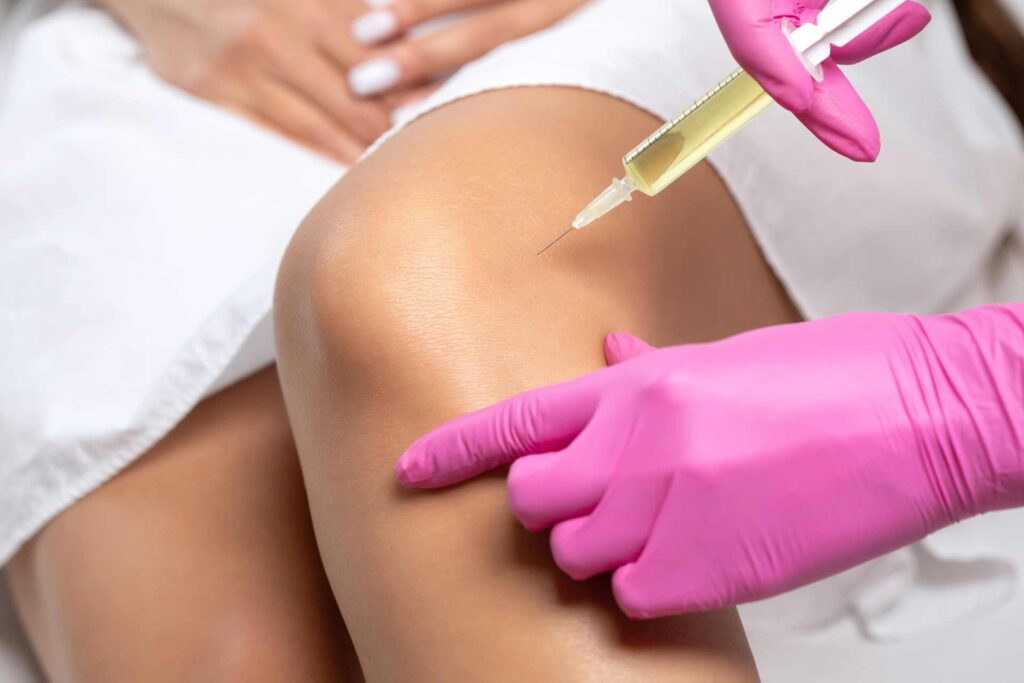
A treatment that uses patient’s own blood cells to accelerate healing of injury like Chronic Tendon Injuries, some Ligament and Muscle Injuries, and Knee Arthritis.
How PRP for injuries and joints works
PRP stands for platelet-rich plasma. A small amount of your own blood is drawn and spun in a centrifuge to separate a plasma layer with a higher concentration of platelets. Platelets carry growth factors that play a role in the body’s natural repair process. This prepared plasma is then injected into the injured tendon, ligament, muscle or joint. Results vary from person to person.
For many people, treating a nagging tendon or joint problem is about staying active for years to come, and PRP is usually considered as one part of a longer-term plan that includes exercise and follow-up.
Who is PRP for?
- Chronic tendon problems such as tennis elbow, Achilles or patellar tendinopathy and rotator cuff tendinopathy
- Ligament and muscle injuries, including sports injuries
- Mild to moderate knee osteoarthritis and other joint pain
PRP may not be suitable during pregnancy, with active infection, cancer, certain blood or platelet disorders, or with some blood-thinning medicines. The doctor reviews this with you first.
What to expect at Tadawi Medical Center
Treatment starts with an orthopedic assessment to confirm the diagnosis and check that PRP is a suitable option; imaging may be reviewed or requested. On the treatment day, blood is drawn from your arm, the PRP is prepared, and the area is cleaned before the injection, which may be guided by ultrasound for accuracy. Mild soreness or swelling for a few days is common. The doctor will advise on rest, which pain relievers to use or avoid, and when to start physiotherapy or return to sport.
Related treatments at Tadawi
For knee pain specifically, see PRP Therapy for Knees. Other options include Joint Injections and Ultrasound-Guided Joint & Tendon Injections, all starting with an Orthopedics Consultation.
Frequently asked questions
Is PRP injection painful?
You may feel a sting and pressure during the injection and some soreness afterwards. The doctor can use local anesthetic or cooling to make it more comfortable.
How many PRP sessions will I need?
It depends on the condition. Some patients have one injection, others a short course spaced weeks apart. The doctor will recommend a plan after the assessment.
Is there downtime after PRP?
Most people resume daily activities soon after, avoiding heavy strain for a period advised by the doctor.
How much does PRP cost in Doha?
PRP for injuries and joints at Tadawi Medical Center is priced from 1500 QAR. The final cost depends on the area treated and the number of sessions, and it is confirmed after your assessment. You can see current prices on this page or ask our team on WhatsApp.




